Dual-Task Interference: A Multiple Resource Theory Experiment
A browser-based experiment comparing Tetris played alone with Tetris paired with a visual mental rotation task or an auditory phoneme task, to test which pairing costs more.
- Course
- Human Information Processing
- My role
- Experiment design & implementation
- Partner
- Andrew Jones
- Method
- Within-participant, three conditions
- Status
- Data collected, analysis next
I designed the experiment, recorded and processed the auditory stimuli, selected the mental rotation stimuli, and built the interface. My partner, Andrew Jones, helped refine the hypotheses and design, such as running Tetris alone first and counterbalancing only the two dual-task conditions.
The question
When we do two things at once, how much they interfere depends partly on which mental resources each task uses. This experiment turns that prediction into three comparable, timed blocks.
Research question: Does Tetris performance drop more, and does perceived workload rise more, when Tetris is paired with visual mental rotation than when it’s paired with auditory phoneme discrimination?
Data collection is complete. Analysis in SPSS is under way, and results will be added here after the final APA write-up.
The prediction
Multiple resource theory (MRT) predicts more interference when two tasks draw on the same processing resources. Tetris needs continuous visual monitoring, spatial planning, and manual control, so the two secondary tasks overlap with it to different degrees (Wickens et al., 2022).
- Tetris + mental rotation: more overlapBoth are visual, spatial, and manual, so this pairing should cause the larger drop in Tetris performance and the larger rise in NASA-TLX workload.
- Tetris + phonemes: less overlap, not noneThe input is auditory and verbal rather than visual and spatial, sharing only the manual response, so it should cost less. Response selection and timing can still compete.
Recent computational MRT work found that modeling resource conflict, not just demand, improves predictions of dual-task interference, and that people may protect the harder task, leaving the easier one to absorb the cost (El Iskandarani et al., 2025).
Study design
- Consent and eligibility. Participants confirm they agree to take part and are at least 18, then self-report normal or corrected-to-normal vision and normal hearing. A short demographic survey is optional.
- Instructions and setup. The procedure and response keys are explained, participants set a comfortable screen brightness and sit about two feet from the screen, then put on headphones for a sound check.
- Practice. Each task is practiced alone for 30 seconds, in order: Tetris, phoneme discrimination, then mental rotation. The judgment tasks use six simpler pairs and show whether each answer was correct.
- Test blocks. Three three-minute blocks: Tetris alone always first as the baseline, then the two dual-task blocks in counterbalanced order. Judgments no longer show feedback.
- Workload and data. A NASA-TLX follows every test block, and a CSV of all responses downloads at the end.
Instructions and controls appear before every practice and test block. Participants move between sections at their own pace, but once a block starts it runs to the end.
| Order | Condition | Participant does | Tests |
|---|---|---|---|
| 1st, always | Tetris alone | Plays the falling-block game. | The baseline for performance and workload. |
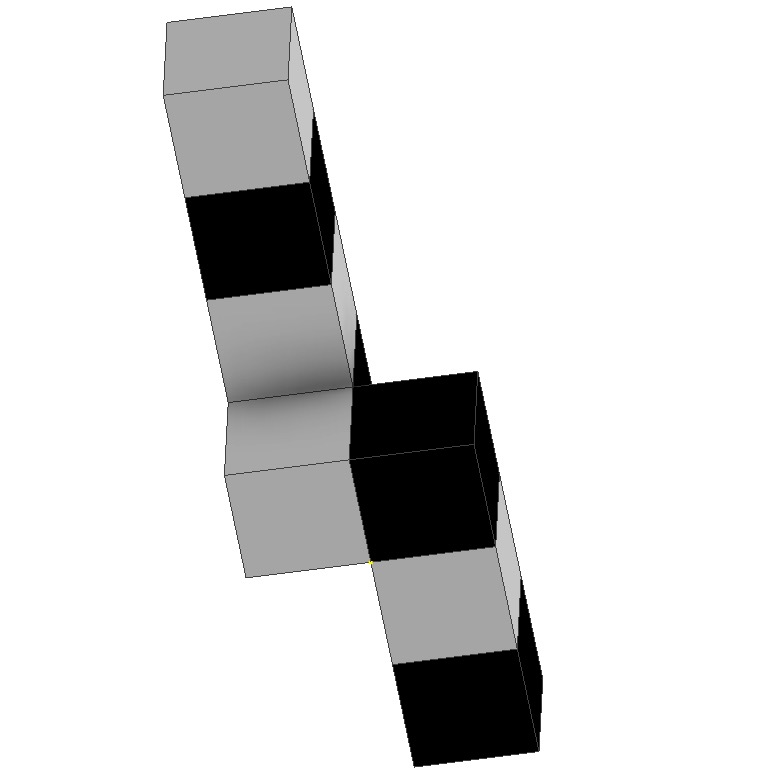
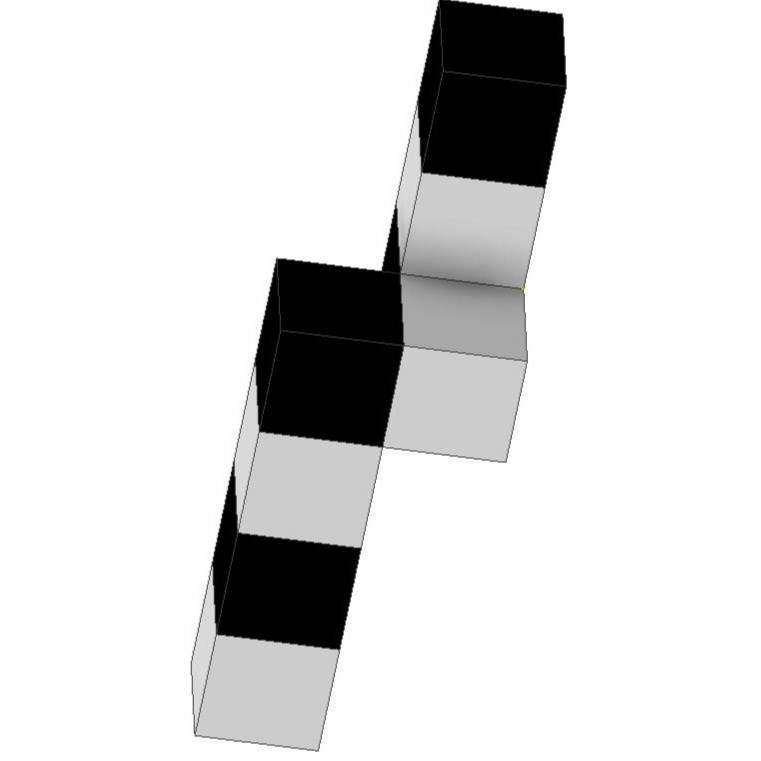
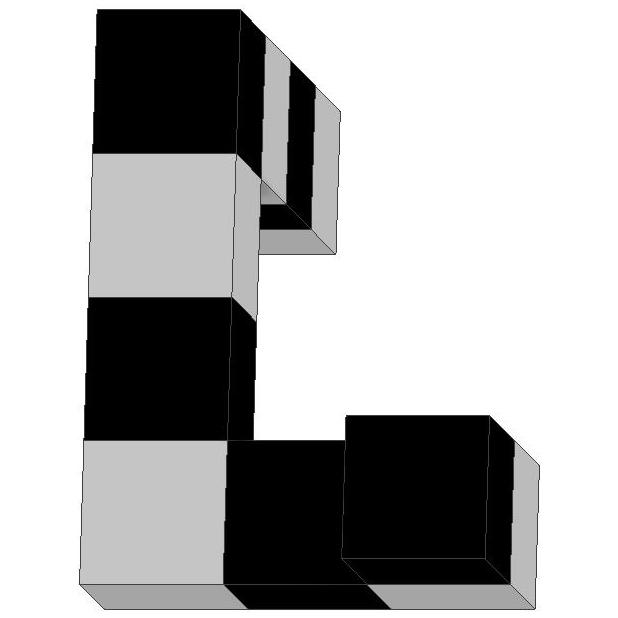
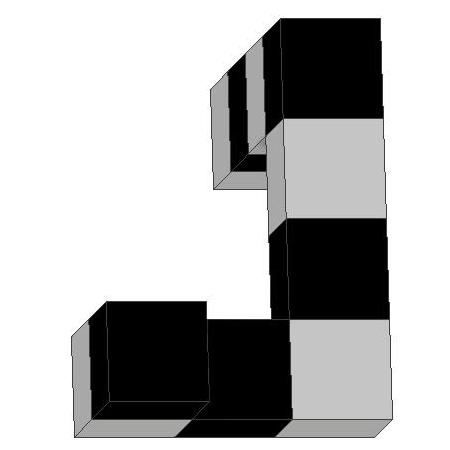
| 2nd or 3rd | Tetris + mental rotation | Plays while judging whether two 3D figures are the same shape. | High overlap: visual, spatial, and manual. |
| 2nd or 3rd | Tetris + phoneme discrimination | Plays while judging whether two sounds are the same. | Low overlap: only the manual response is shared. |
- Same exposureEvery test block lasts three minutes.
- Self-paced judgmentsA new pair appears 0.5 seconds after each answer and pairs keep coming until time runs out, so there’s no set number of trials. Test pairs are drawn at random from a set of 50.
- Shared keysA means same and F means different in both judgment tasks; the arrow keys and Space control Tetris.
Variables
| Variable | Role | Levels or measures |
|---|---|---|
| Task condition | Independent variable | Tetris alone; Tetris + mental rotation; Tetris + phoneme discrimination |
| Tetris performance | Dependent variable | Placement time, pieces placed, and holes |
| Secondary-task performance | Dependent variables | Response accuracy, reaction time, and number of trials completed |
| Perceived workload | Dependent variables | Six NASA-TLX ratings and an overall unweighted score after each test block |
The two secondary tasks
- Mental rotationModeled after Shepard and Metzler (1971). Each pair shows two cube-based 3D figures from Kim, Lester, and Yang (2025): the same shape rotated in the picture plane or in depth, or a figure beside its mirror image.
- Phoneme discriminationModeled after Altmann et al. (2014), building on Liberman et al. (1957). Each trial plays two steps from a seven-step /ga/ to /ba/ continuum, 0.5 seconds apart, and an answer counts only once both have played.
I recorded the syllables myself, one /ba/ and one /ga/, then built the seven-step continuum between them in Praat with Claude’s help. Steps 2 to 6 are ambiguous blends designed to be hard to tell apart. Listen with headphones:
- Step 1
- Step 4
- Step 7
Try the conditions
Play a 60-second block of Tetris alone, then pair it with either task and compare. The demo uses the experiment’s stimuli, self-paced timing, and keys, but records nothing and isn’t part of the study.
Needs a physical keyboard; headphones recommended for the phoneme condition.
The build
The study runs as a single HTML page that walks each participant through consent, eligibility, optional demographics, instructions, practice, the test blocks, workload ratings, and completion. Tetris is drawn on a canvas, and the image and sound files load from a companion stimuli/ folder.
- TetrisThe seven standard pieces arrive in shuffled sets (Pajitnov, 1984) and fall one cell every 650 ms. Arrow keys move, rotate counterclockwise, and soft-drop; Space hard-drops. A top-out clears the board and play continues.
- WorkloadAfter every test block, participants rate six NASA-TLX dimensions from 0 to 100. The page reports an unweighted raw TLX mean, not the weighted score (NASA Ames Research Center, 1986).
- DataFor each judgment it records the correct answer, the response, accuracy, and reaction time; for Tetris, placement time, pieces placed, and holes in the stack.
- PrivacyA combined CSV downloads to the participant’s own device at the end. The page uploads nothing.
Current state: data collection is complete, and the participant CSV files are ready for analysis.
The analysis plan
The analysis runs in SPSS. The main comparisons are on Tetris, the task every condition shares: placement time, pieces placed, and holes in Tetris alone against each dual-task block give each pairing’s cost, and the two costs are then compared, alongside NASA-TLX workload for each block.
Secondary-task accuracy, reaction time, and trials completed describe how participants handled each judgment. Because the judgments are self-paced, trials completed shows how much attention each task drew. Rotation and phoneme scores aren’t compared directly, since the tasks differ in stimuli, and reaction time is read alongside accuracy to catch speed–accuracy trade-offs.
Next steps
- Prepare the data. Combine the participant CSVs, apply the exclusion rules, and compute each block’s Tetris, secondary-task, and workload measures.
- Analyze in SPSS. Compare the three conditions on Tetris performance and workload, and report effect sizes and uncertainty alongside any differences.
- Write it up. Report the study as a final APA-style paper.
- Update this page. Add the results and what they mean for multiple resource theory.
What I want to learn: whether visual-spatial overlap causes a bigger measurable cost to Tetris than a cross-modal pairing, and whether reported workload rises with it.
Sources Show all 11Hide
- Altmann, C. F., Uesaki, M., Ono, K., Matsuhashi, M., Mima, T., & Fukuyama, H. (2014). Categorical speech perception during active discrimination of consonants and vowels. Neuropsychologia, 64, 13–23. https://doi.org/10.1016/j.neuropsychologia.2014.09.006
- Boersma, P., & Weenink, D. (2026). Praat: Doing phonetics by computer [Computer software]. https://www.praat.org
- El Iskandarani, M., Wickens, C. D., Bolton, M. L., & Riggs, S. L. (2025). A computational multiple resource theory approach to modeling dual-task interference in VR: The roles of resource demand, resource conflict, visual angle separation, and task priority. Proceedings of the Human Factors and Ergonomics Society Annual Meeting, 69(1), 1540–1546. https://doi.org/10.1177/10711813251358799
- Kim, J. Y., Lester, C., & Yang, X. J. (2025). Beyond binary decisions: Evaluating the effects of AI error type on trust and performance in AI-assisted tasks. Human Factors, 67(10), 1062–1083. https://doi.org/10.1177/00187208251326795
- Liberman, A. M., Harris, K. S., Hoffman, H. S., & Griffith, B. C. (1957). The discrimination of speech sounds within and across phoneme boundaries. Journal of Experimental Psychology, 54(5), 358–368. https://doi.org/10.1037/h0044417
- Massaro, D. W., & Hary, J. M. (1983). Speech perception and psychophysics: Theory and experiment. Perception & Psychophysics, 34(5), 499–502.
- NASA Ames Research Center. (1986). NASA Task Load Index (NASA-TLX), version 1.0: Paper and pencil package. Human Performance Research Group, NASA Ames Research Center.
- Pajitnov, A. (1984). Tetris [Video game]. Dorodnitsyn Computing Centre, USSR Academy of Sciences.
- Shepard, R. N., & Metzler, J. (1971). Mental rotation of three-dimensional objects. Science, 171(3972), 701–703. https://doi.org/10.1126/science.171.3972.701
- Tartter, V. C. (1982). Vowel and consonant manipulations and the dual-coding model of auditory storage: A re-evaluation. Journal of Phonetics, 10(2), 217–223.
- Wickens, C. D., Helton, W. S., Hollands, J. G., & Banbury, S. (2022). Engineering psychology and human performance (5th ed.). Routledge.